The lead quit.
The backlash is real. But it's not the AI that's the problem —
it's that nobody is checking the AI.
The Self-Improving
PR Review Agent
A PR-review agent that learns from your team, not just benchmarks — it rewrites its own prompts from what reviewers actually say, and it's honest about when it's unsure.
HGM · Huxley–Gödel Machine · ICLR 2026 oral
AI writes code faster.
Review didn't get faster.
- The reviewer is the rate-limiting step in shipping AI-written code.
- AI code is semantically plausible but behaviorally wrong — it compiles, it reads fine, it still ships a bug.
- Architectural drift: each PR nudges the design; no one holds the whole.
Review is a DORA problem.
A reviewer that gets better
with every review.
- The agent reviews a PR → a human grades it in 30 seconds → the agent rewrites its own prompts from what the reviewer said.
- The human is the reward signal. The tree remembers which review styles your team trusts.
- Small, local — no cloud, no 400B model. ~3–4 min/review on one GPU, sized for an async review gate.
Watch it work.
A PR with a planted bug — reviewed, then graded by a human in 30 seconds. That 30 seconds is the reward signal.
→ live demo · the review is pre-warmed; the rubric is the live moment · (fallback: replay)
MergeFlow, on a real repository.
MohammadEmad2003/erp-shop — a shop ERP with seven real, unreviewed pull requests. A quick tour, then we review them live, in front of you.
It changed — exactly as you asked.
Every human rubric produced a real, inspectable mutation to the prompt. The loop closes end-to-end — the human pilot scales the evidence.
It holds up at scale —
and on a dataset it never saw.
Same model (Qwen 27B), same harness — only the prompt changed. Scoring: identical match_findings (file + line-tol=10).
Three reviewers. Ten PRs.
The word “human,” made real.
Three independent expert reviewers — no notes shared, no consultation — each graded all 10 HGM reviews on the same 5-point rubric. 30 evaluations, every one logged.
n = 30 evaluations · 3 independent reviewers × 10 PRs · 80% of reviewers rated their own confidence High. The misses are the training signal — that's what the loop eats.
Claude is a great reviewer.
It's also a static one.
- ·f(prompt, diff) → review — a pure function
- ·No memory of your team, your standards, your bugs
- ·Same input → same output, forever
- ·Can't be wrong in a way it learns from
- ·State: a tree of prompt variants (Beta posteriors)
- ·Reward: your team's 30s rubric → utility
- ·Mutation: prompt-only self-improve
- ·Output changes over time — that's the difference
"Claude is a tool you use. This is a system that improves itself from your team's feedback."
Every famous tool is a stateless detector.
Only this one is a stateful learner.
The question isn't "AI or not" — CodeRabbit, DeepSource and Copilot all call an LLM. The question is: does it maintain a state that improves from your team? None of them do. They compute a fixed function of your code and plateau.
| Capability | SonarQube | CodeRabbit | CodeClimate | DeepSource | Copilot | Ours |
|---|---|---|---|---|---|---|
| Learns from your team's reviewers | ✗ | ✗ | ✗ | ✗ | ✗ | ✓ |
| Human-in-the-loop reward signal | ✗ | ✗ | ✗ | ✗ | ✗ | ✓ |
| Calibrated (penalized for overconfidence) | ✗ | ✗ | ✗ | ✗ | ✗ | ✓ |
| Auditable self-improvement | ✗ | ✗ | ✗ | ✗ | ✗ | ✓ |
| Local / data sovereignty | ✓ | ✗ | ✗ | ✗ | ✗ | ✓ |
Static tools plateau. This is the only stage in the pipeline whose output changes over time — and compounds.
The loop under the hood.
An agent is an LLM + a harness.
HGM is the loop that wraps it.
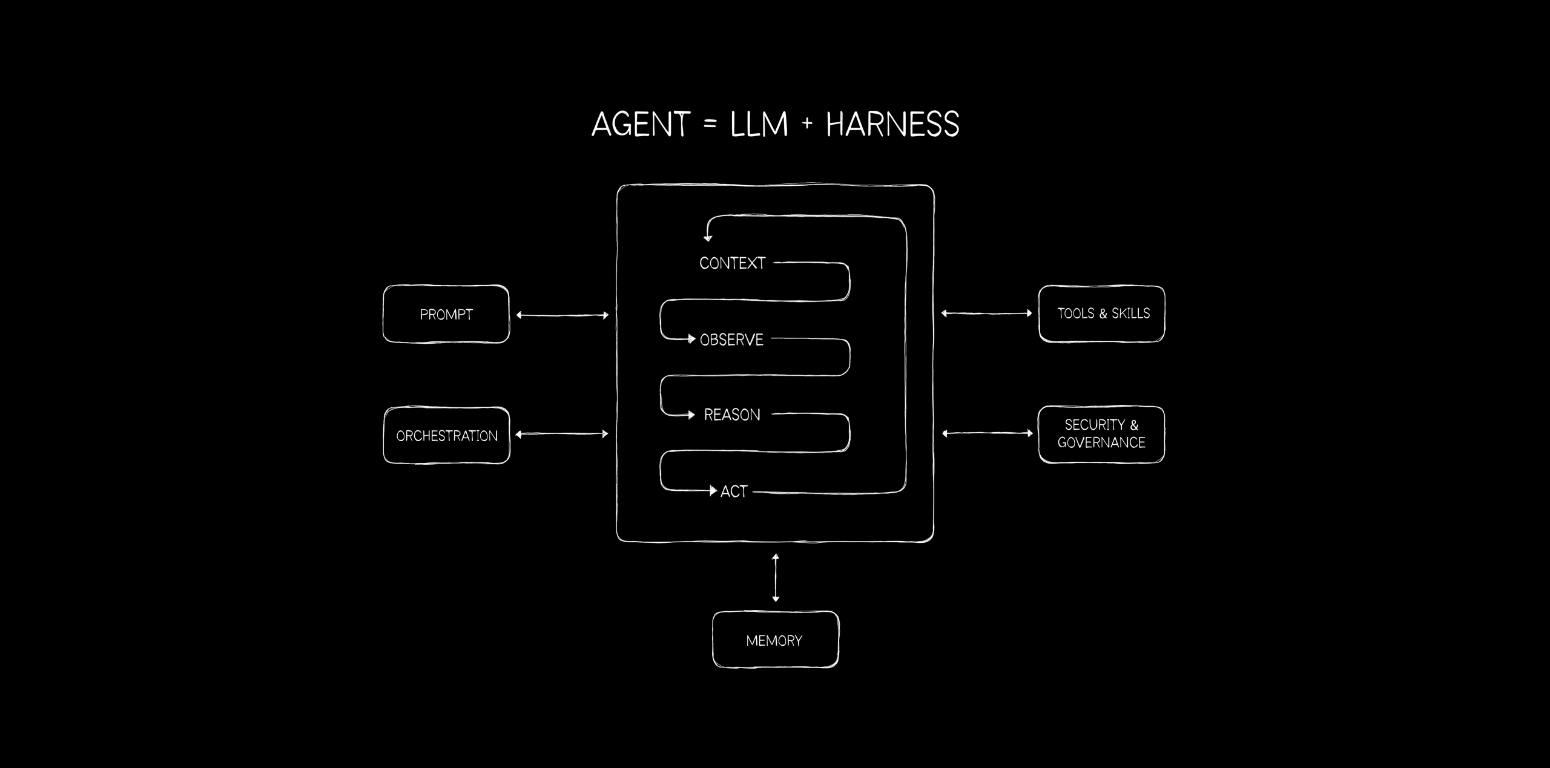
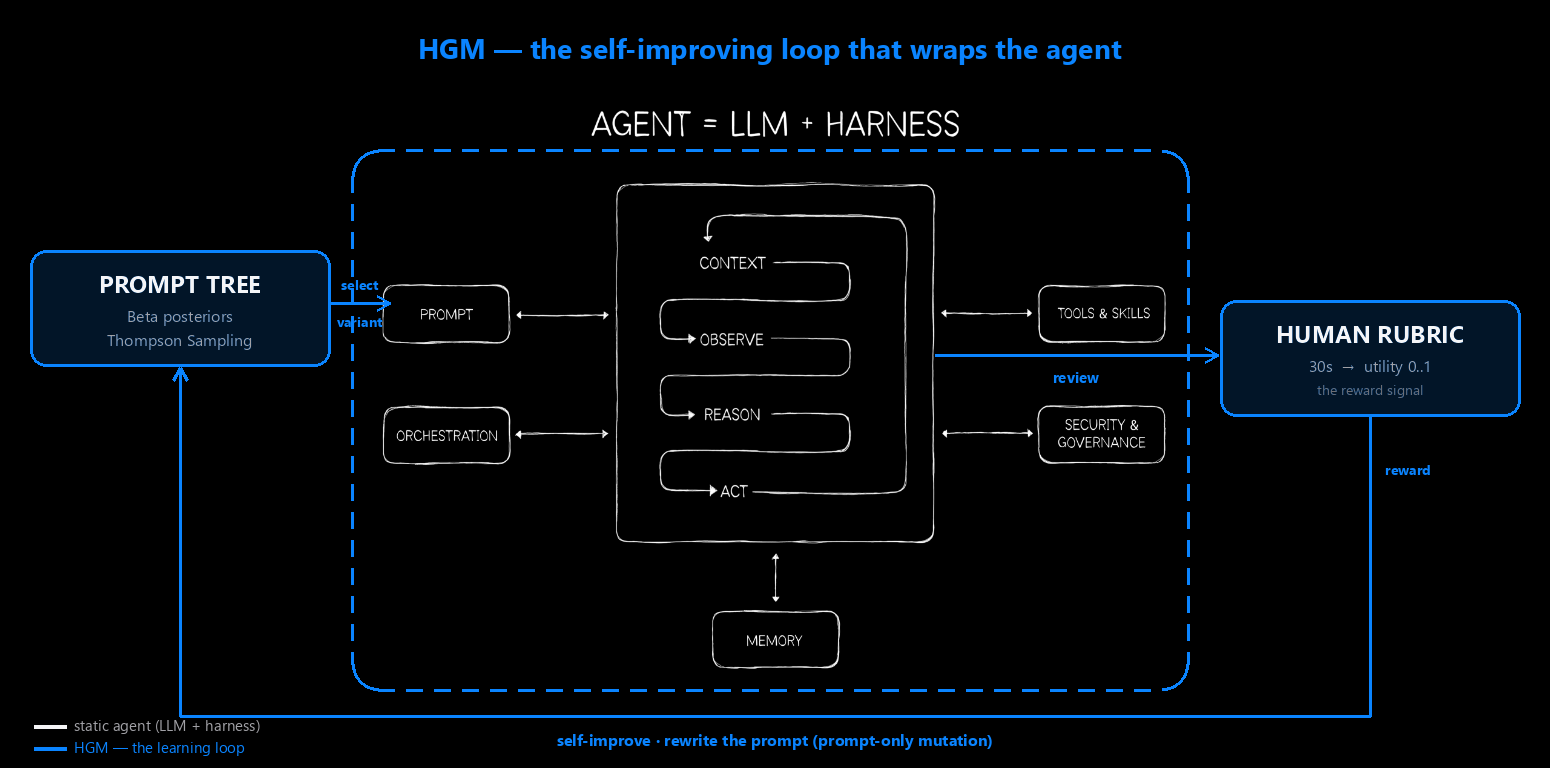
White = the agent (any LLM + harness). Blue = HGM — the stateful, self-improving layer. Swap the LLM; keep the loop.
The reward is a function,
not a vibe.
utility · [0,1]What a review is worth
Three rubric taps → a scalar. signal = did it find real issues, action = was the approve/block call right, base = it produced a review at all. A missed bug subtracts. Three taps on purpose — cheap enough to grade every review, which is what lets the loop close.
the mapsHow taps become numbers
Real code: feedback/__init__.py · compute_review_utility() — the same scalar that drives the tree.
How it picks a reviewer.
Thompson SamplingExplore vs. exploit, per node
Each prompt variant is a Beta posterior — a running score of how much trust it earned. Sampling (not argmax of the mean) means a less-evaluated variant still gets a chance: that's the explore term. A proven variant keeps winning: that's exploit.
real tree · after 3 reviewsWhere the mass sits
The tree is a tree, not a list: children inherit from the best parent, so improvement is a lineage, not a replacement. (v0–v2 share a base prompt today; the tree differentiates on mutation.)
At scale: 800 evals · 56 prompt variants — each eval = one real PR review.
Real code: demo_server.py · _ts_select() — replicates hgm.py:TS_sample().
It's honest about
when it's unsure.
the gateConfidence vs. a threshold that learns
annealingThe gate only relaxes on earned trust
calibrationConfidence must track reality
Real code: compute_annealed_threshold() + compute_hybrid_utility() — the gate and the penalty are both in the repo.
How it rewrites itself.
the mutationPrompt-only, never the code
The model is asked to rewrite its own instructions to fix the exact weakness the human named. It can change how it thinks — never what it ships. reject_code_diffs=True.
the resultA new node, a logged lineage
Real code: demo_server.py · _real_self_improve() — a real, logged mutation, not a simulated one.
Where it sits — and why it wins.
We're not replacing SonarQube — static analysis is solved. We're the learning layer on top, and the only one that gets better with your team.
Responsible AI by design.
| Principle | Real code |
|---|---|
| Human oversight | compute_annealed_threshold — uncertain → human, confident → auto |
| Calibration / honesty | compute_hybrid_utility overconfidence penalty |
| Privacy / sovereignty | model_manager — local Qwen/Ornith, no cloud |
| Transparency | improvement_log.jsonl — every self-edit logged |
| Safety / containment | reject_code_diffs=True — prompt-only mutation |
| Stability | threshold annealing (window = 50) |
The numbers.
Roadmap.
The people behind it.





The human is the reward signal.
A PR-review agent that learns from your team, not just benchmarks — and is honest about when it's unsure.
HGM · Huxley–Gödel Machine · ICLR 2026 oral